Digital Marketing for Ecommerce: AI-Powered Growth Strategy for 2026
Digital marketing for ecommerce has become the backbone of online business growth in 2026. With increasing competition, ecommerce brands need smarter, faster, and more data-driven strategies to attract customers and increase sales. Traditional marketing is no longer enough to scale online stores effectively.
Today, AI-powered digital marketing is transforming how ecommerce brands run ads, optimize conversions, and target the right audience. From automated ad campaigns to personalized customer journeys, businesses can now achieve higher ROI with lower acquisition costs.
This guide will help you understand how digital marketing for ecommerce works, why it is essential, and how AI is reshaping the future of online store growth.
What is Digital Marketing for Ecommerce?
Digital marketing for ecommerce refers to the use of online channels like SEO, social media, paid ads, and email marketing to promote and grow online stores. It focuses on driving traffic, increasing conversions, and improving customer retention for ecommerce businesses.

The Problem Most Ecommerce Brands Face
Let’s be honest. Most ecommerce brands are stuck in a loop:
They spend on ads, get some sales, can’t figure out what worked, and repeat. The cost of customer acquisition keeps going up. Return on ad spend keeps dropping. And every month feels like a gamble.
The root problem is not the product. It’s not even the budget. It’s that most ecommerce marketing is still based on guesswork — broad audiences, generic creatives, and campaigns built on assumptions.
AI changes that entirely.
Why Ecommerce Brands Need Digital Marketing in 2026
In 2026, ecommerce competition is more intense than ever. Without digital marketing, brands struggle to reach their target audience and generate consistent sales. Digital marketing helps ecommerce businesses build visibility, attract qualified traffic, and scale revenue efficiently.
Key Digital Marketing Channels for Ecommerce Growth
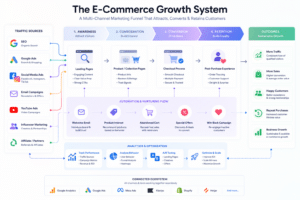
Ecommerce brands use multiple digital channels such as SEO, Google Ads, Meta Ads, influencer marketing, and email marketing to reach customers at different stages of the buying journey. Each channel plays a specific role in driving traffic and conversions.
How AI is Transforming Digital Marketing for Ecommerce
AI is revolutionizing digital marketing by automating ad optimization, improving audience targeting, and predicting customer behaviour. Ecommerce brands can now run smarter campaigns with better ROI and reduced ad spend wastage.
What This Means for Your Ecommerce Brand
If you’re an ecommerce brand that’s been relying on boosted posts, generic ads, and one-size-fits-all campaigns, there’s a large gap between where you are and where you could be.
AI-powered marketing closes that gap — faster targeting, real personalization, self-optimizing campaigns, smarter SEO, and automated revenue flows working around the clock.
The brands that adopt this approach now will build a compounding advantage that gets harder to close every month.
Ready to Grow Your Ecommerce Brand with AI Marketing?
At AI Marketing Lab, we work with ecommerce brands to build AI-powered marketing systems that drive real, measurable growth — from performance marketing and SEO to email automation and brand building.
We’re a Hyderabad-based digital marketing agency working with brands across India, the UK, Australia, and the UAE.
Conclusion
Digital marketing for ecommerce is no longer optional—it is essential for survival and growth. With AI-powered strategies, ecommerce brands can scale faster, reach better audiences, and achieve higher profitability in 2026 and beyond.
Today, digital marketing for ecommerce is driven by data, automation, and customer behavior insights rather than guesswork. Brands that adopt AI-based optimization, performance marketing, and conversion-focused strategies are seeing significantly better ROI compared to traditional methods.
As competition continues to increase in the ecommerce space, businesses that invest in structured digital marketing systems will consistently outperform those relying only on organic reach or basic advertising.
Ultimately, success in ecommerce depends on how effectively brands use digital marketing for ecommerce to attract, convert, and retain customers at scale.