Most businesses buy content marketing services the way they buy stock photos — grab something that looks reasonable, hope it works, move on. Then three months later there’s a blog with twelve posts, none of them ranking, traffic barely moving, and nobody on the team can say why.
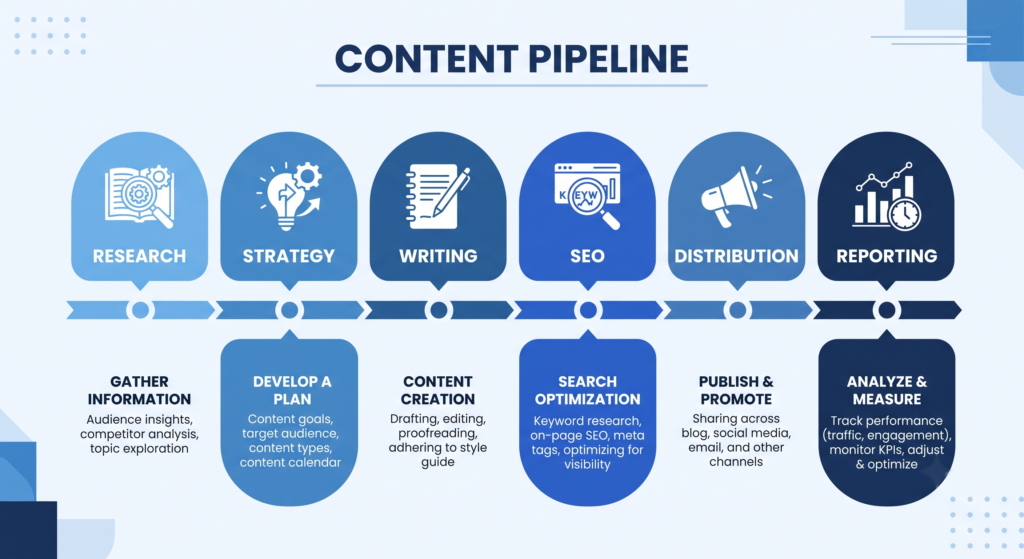
Here’s the thing: content marketing services aren’t blog posts. They’re a system — research, strategy, writing, distribution, and measurement, all pointed at a business outcome. Skip any one piece and the rest is just words on a page.
This article breaks down what’s actually inside a strong content package, where most businesses overpay or underbuy, and how to tell a content marketing agency that knows what it’s doing from one that’s just filling a content calendar.
What’s Actually Included in Content Marketing Services
Ask ten agencies what content marketing services means and you’ll get ten different scopes. That’s not dishonesty — it’s an industry where the term got stretched to cover everything from a single blog post to a full demand-gen engine.
At minimum, a real package includes:
- Strategy and audience research — who you’re writing for, what they’re searching, where they are in the buying cycle.
- Keyword and topic mapping — tying content to actual search demand, not just what sounds interesting internally.
- Content production — blogs, guides, case studies, video scripts, whatever format fits the audience.
- On-page SEO and technical setup — meta tags, internal linking, schema markup, the unglamorous stuff that decides whether content gets found at all.
- Distribution — email, social repurposing, syndication. Content that sits on a blog with zero promotion rarely earns its budget back.
- Reporting tied to business metrics — traffic is a vanity number on its own; leads, signups, and pipeline influence are what actually matter.
Most packages skip at least one of these pieces — usually distribution or reporting — because they’re less visible than “we wrote you 8 blog posts this month.” Ask what’s included before signing, not after the first invoice.

Why Content Marketing Strategy Has to Come Before Content
A content marketing strategy isn’t a nice-to-have planning document nobody reads again. It’s the thing that decides whether the next twelve months of writing point at a real business goal or just fill a calendar.
Without a strategy, content production defaults to whatever sounds good in a brainstorm. With one, every piece maps to a specific search intent, a specific stage of the funnel, and a specific metric it’s supposed to move. That difference shows up in results within a quarter, not a year.
A real content marketing strategy answers three questions before a single word gets written: who’s searching for this, what do they need to see to trust us, and what happens after they read it. Skip that groundwork and even excellent writing underperforms, because it’s aimed at nothing in particular.
This is also where a lot of businesses get burned. They hire for content writing services alone, get technically solid articles, and still see no movement in traffic or leads — because nobody built the content marketing strategy the writing was supposed to execute against.
Content Marketing Agency vs. In-House Team vs. Freelancer
This decision matters more than most businesses treat it. Same budget, three very different outcomes depending on who’s doing the work.
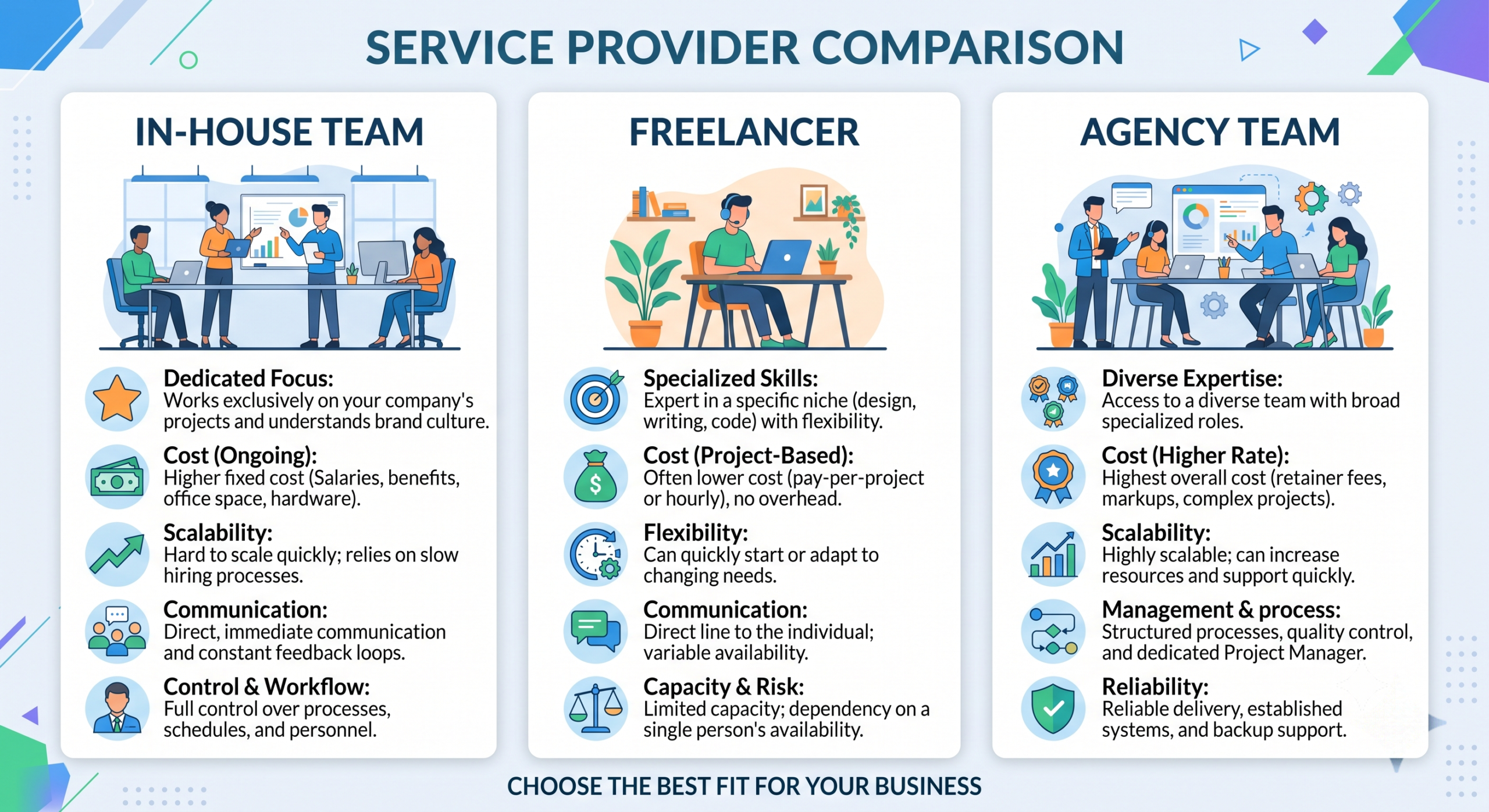
An in-house team knows the product and the customer better than anyone outside the company ever will. The tradeoff: hiring a strategist, writer, and SEO specialist in-house costs more than most businesses expect, and ramping a new hire up on strategy takes months most teams don’t have.
A freelancer works well for a single deliverable — one strong case study, one well-researched guide. Ask a solo freelancer to run strategy, production, SEO, and distribution simultaneously, and something usually slips, most often distribution and reporting, because those are the parts that don’t show up in a first draft.
A content marketing agency sits in the middle and, done right, brings a full team without the in-house overhead: a strategist, a writer, an SEO specialist, and someone tracking what’s actually converting. The premium over a freelancer buys structure and accountability. A content marketing agency worth paying for will walk you through their thinking before touching a single blog post — if a proposal jumps straight to a content calendar, that’s the tell to walk away.
Where SEO Content Marketing Fits Into the Bigger Picture
SEO content marketing gets treated as a separate discipline from “regular” content marketing, and that split causes more wasted budget than almost anything else in this space.
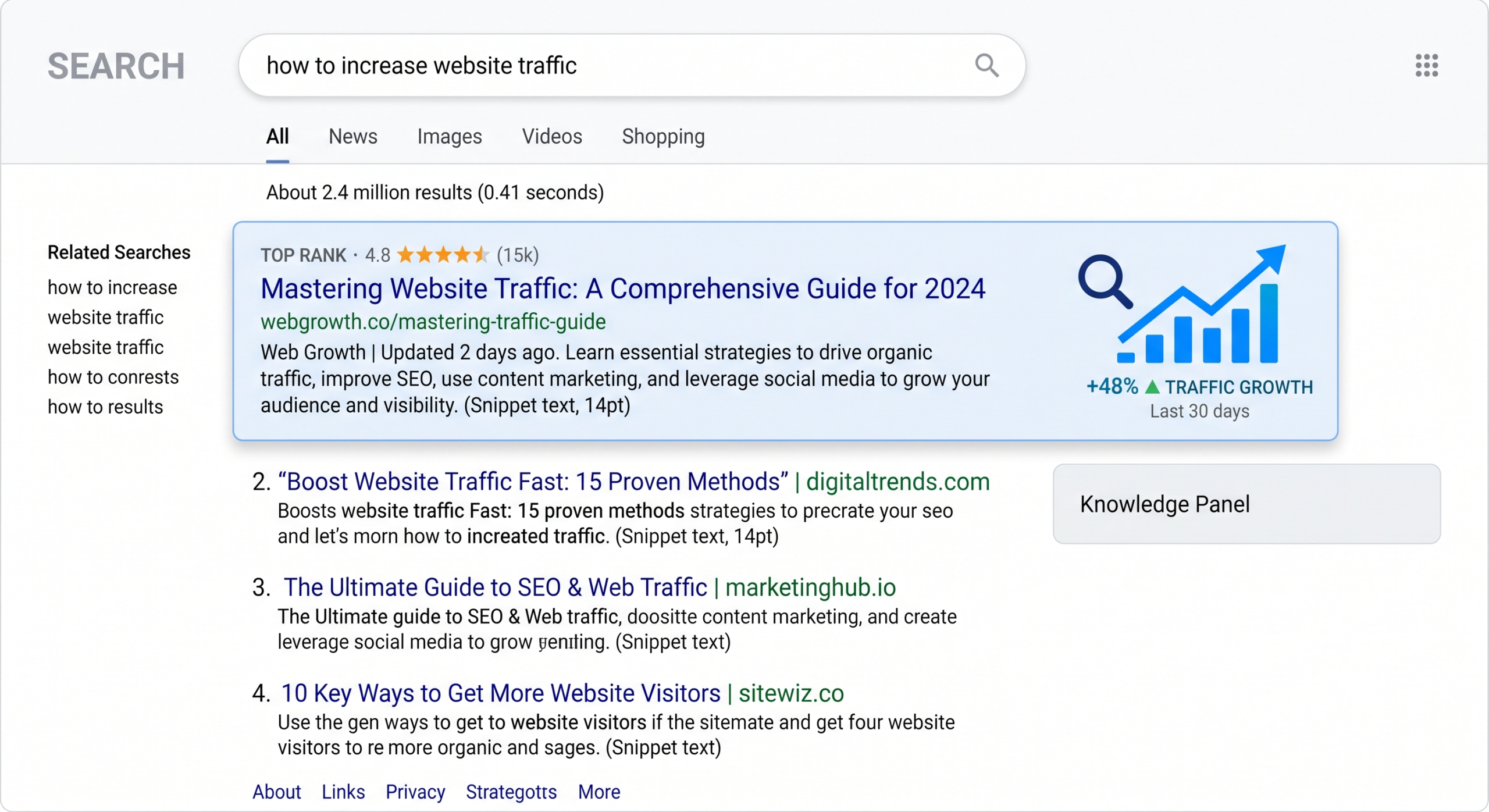
Here’s the reality: content that isn’t built around search intent from the start rarely ranks well no matter how well-written it is. SEO content marketing isn’t a bolt-on you add after the writing is done. It’s baked into the topic selection, the headline structure, the internal linking, and the on-page setup from the first outline.
Good SEO content marketing also isn’t about stuffing keywords until a sentence reads like a robot wrote it — Google’s algorithm has been good at spotting that for years now. It’s about matching content depth and structure to what a searcher actually needs, then making sure the technical side (page speed, mobile rendering, schema) doesn’t undercut good writing.
A business investing in content marketing without SEO content marketing baked in is essentially publishing into a void. Traffic doesn’t show up because nobody asked what people are searching for before writing the piece — and no amount of polish after the fact fixes that gap.
Content Writing Services — The Piece Everyone Underestimates
Content writing services sound like the easy part. Hire someone who can write, hand them a topic, get a blog post back. In practice, this is where a lot of content marketing budgets quietly go to waste.
Generic content writing services produce technically correct articles that say nothing a competitor’s post doesn’t already say. The strong version does something different: subject-matter research, a distinct point of view, and writing that sounds like it came from people who actually understand the industry, not a template with the client’s name swapped in.
The gap between mediocre and strong work rarely shows up in grammar. It shows up in whether a reader trusts the piece enough to take the next step — book a call, download a guide, sign up. That’s the actual job content writing services are meant to do, and it’s why the cheapest quote is rarely the best value here.

What Content Marketing Services Actually Cost
Budget expectations are where a lot of first conversations go sideways, mostly because pricing gets quoted at wildly different points depending on scope.
A single freelance writer producing 4 blog posts a month, no strategy attached, might run ₹15,000-₹40,000 monthly. That covers writing only — someone still has to decide what to write about, optimize it for search, and get it in front of an audience.
An agency running full strategy, production, SEO, and distribution for a small-to-mid-size business typically sits between ₹60,000 and ₹2,50,000 a month, depending on volume and channel mix. Enterprise engagements with multiple content workstreams, video, and dedicated reporting can run well past that.
The number that matters less than the topline monthly fee is cost per qualified outcome — cost per lead, cost per demo booked, cost per ranking keyword. A ₹1,50,000/month retainer that generates 40 qualified leads beats a ₹40,000/month writer-only arrangement that generates none, even though the second number looks cheaper on a spreadsheet. Ask any agency to walk through expected outcomes at their price point before comparing quotes on cost alone.
Common Mistakes That Waste Content Marketing Budget
A few patterns show up again and again in accounts that switch agencies after a bad first year — and almost all of them trace back to skipping a step, not to bad writing.
Chasing volume over relevance. Publishing four posts a week sounds productive. If none of them target real search demand, it’s just noise — and it burns through budget that could have funded fewer, sharper pieces. A strategy built around search intent almost always outperforms one built around a publishing quota.
Treating SEO as an afterthought. Content gets written first, then someone tries to “optimize” it after the fact by sprinkling in keywords. SEO content marketing doesn’t work retrofitted — it has to shape the outline before a single paragraph gets drafted.
No distribution plan. A brilliant guide that only lives on the blog, with no email push, no social repurposing, and no internal linking from higher-traffic pages, will underperform a mediocre piece that gets properly distributed. Writing without a promotion plan behind it is only half the job.
Vanity reporting. Pageviews and social shares feel good in a monthly report. They don’t pay rent. Push any agency to report against leads, signups, or revenue influence, not just traffic.
How to Choose the Right Content Marketing Agency
A few questions separate a strong content marketing agency from one that’s just going to hand you a content calendar and hope for the best.
Ask to see their content marketing strategy process before you see a single writing sample — if they can’t explain how they decide what to write about, the writing itself won’t matter much. Ask how they handle SEO specifically: do they do keyword research in-house, or is that outsourced and bolted on afterward? Ask what “content writing services” actually includes in their package — is editing included, how many revision rounds, who owns the final content.
And ask for a reporting cadence tied to business outcomes, not just publishing volume. An agency that reports “12 blog posts published this month” without connecting that to traffic, leads, or pipeline isn’t measuring the thing that matters.
A Quick Real-World Example
A B2B SaaS client came to us publishing two blog posts a week with no strategy behind the topics — whatever the team felt like writing about that month. Traffic was flat for eight months straight, and the internal team had started to assume blogging just didn’t work for their industry.
It wasn’t the writing that was broken. Nobody had mapped the topics to what buyers were actually searching, so every post competed for attention nobody was giving it. We rebuilt their content marketing strategy around actual buyer search behavior, cut publishing volume from eight posts a month to four, and put real research into each one — competitor gaps, actual search volume, and a clear point of view instead of a generic overview.
Within four months, organic traffic was up 61%, and two of the new pieces were driving qualified demo requests directly — something none of the previous 60+ posts had done. Same team size, same budget, completely different approach. The lesson wasn’t “write less.” It was “stop writing without knowing why.”
The Bottom Line
Content marketing services only work when strategy, writing, SEO, and distribution move together instead of getting handled as separate, disconnected line items. A content marketing agency that treats content writing services as the whole job, without SEO content marketing or a real content marketing strategy behind it, is going to produce a blog that looks active and does nothing.
Ask what’s actually in the package before you sign. That single question saves most businesses from a year of publishing into silence.
FREQUENTLY ASKED QUESTIONS
What do content marketing services usually include?
Strategy, keyword research, writing, on-page SEO, distribution, and reporting — not just blog posts.
Do I need a content marketing strategy before hiring writers?
Yes. Without one, content production has no direction and results are much harder to measure or predict.
What’s the difference between a content marketing agency and a freelancer?
An agency brings a full team — strategist, writer, SEO specialist — while a freelancer usually covers one part of the process well.
How is SEO content marketing different from regular content writing?
SEO content marketing builds search intent and technical optimization into the content from the outline stage, not after publishing.
Are content writing services enough on their own?
Not usually — writing without strategy or SEO behind it tends to underperform, even when the writing itself is strong.
How do I evaluate a content marketing agency before signing?
Ask to see their strategy process, their SEO approach, and a reporting cadence tied to leads or traffic, not just publishing volume.