Ask five agencies what a website costs and you’ll get five different numbers, none of them explained. That’s the real problem with website development cost in India — not that it’s expensive, but that almost nobody breaks down what you’re paying for.
Here’s the short version: a basic brochure site starts around ₹15,000. A proper business website with custom design lands between ₹40,000 and ₹1.5 lakh. An ecommerce store with payment gateways, inventory, and admin panels can run ₹1 lakh to ₹8 lakh or more, depending on complexity. Everything in between depends on what you’re actually building.
The long version — the one that saves you from a bad quote or a worse surprise invoice — is what this article covers. We’ll walk through what drives the cost of website development in India up or down, what a fair quote actually looks like, and where most businesses overpay without realizing it.
What Actually Decides Website Development Cost in India
Two businesses can ask for “a website” and land on quotes that differ by 5x. The gap almost never comes from one agency ripping someone off. It comes from scope, and scope is rarely defined clearly on either side of the conversation.
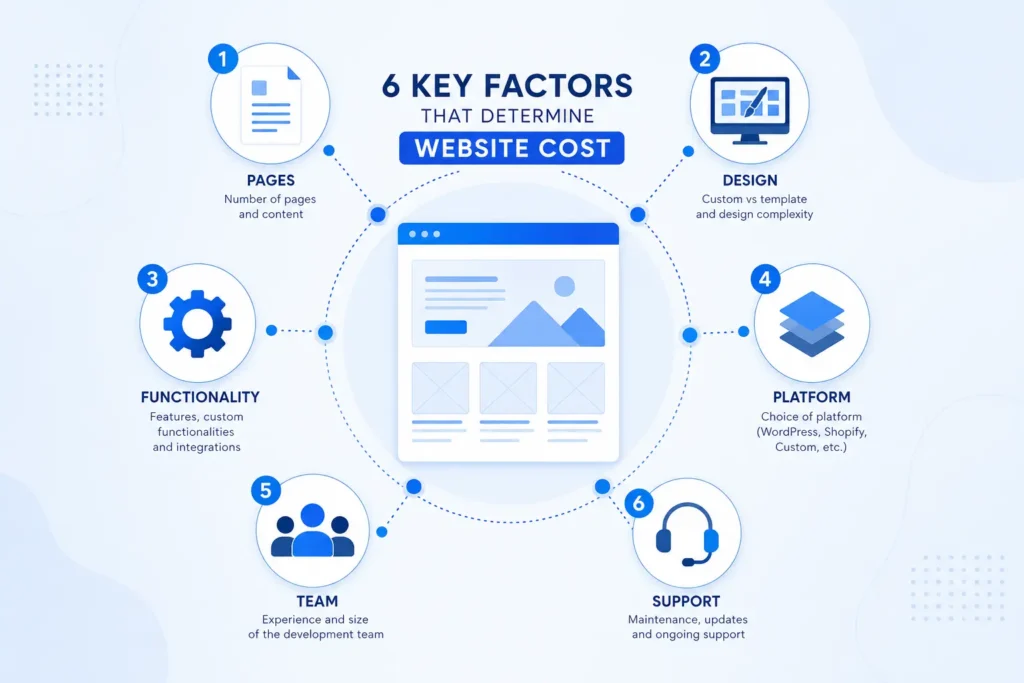
Here’s what moves the number:
- Number of pages and content types — a 5-page site and a 50-page site with blog and case studies are not the same job.
- Custom design vs. template — a designer building your layout from scratch costs more than a theme with your logo dropped in. Both are valid, just priced differently.
- Functionality — booking systems, logins, payment integration, custom dashboards. Each adds development hours, and some add far more than they look like they should.
- Platform choice — WordPress, Shopify, Webflow, or fully custom code all carry different cost of website development in India profiles. WordPress ships fastest; custom code costs more but scales cleaner.
- Team structure — a freelancer, a studio, and a full agency will quote differently for the same brief, and not always in the direction you’d expect.
- Post-launch support — maintenance, hosting, and SSL renewal are often billed separately, and this is where cheap-looking quotes start climbing.
Most freelancers underquote on the base build and then bill separately for hosting, SSL, and revisions. That’s not a real estimate — it’s a teaser rate. Ask for the all-in number before you sign anything, and get it in writing.
Once you understand these levers, the website development cost in India you’re quoted stops feeling random. It starts looking like a direct reflection of the choices you made in the brief.
Cost of Website Development in India — By Website Type
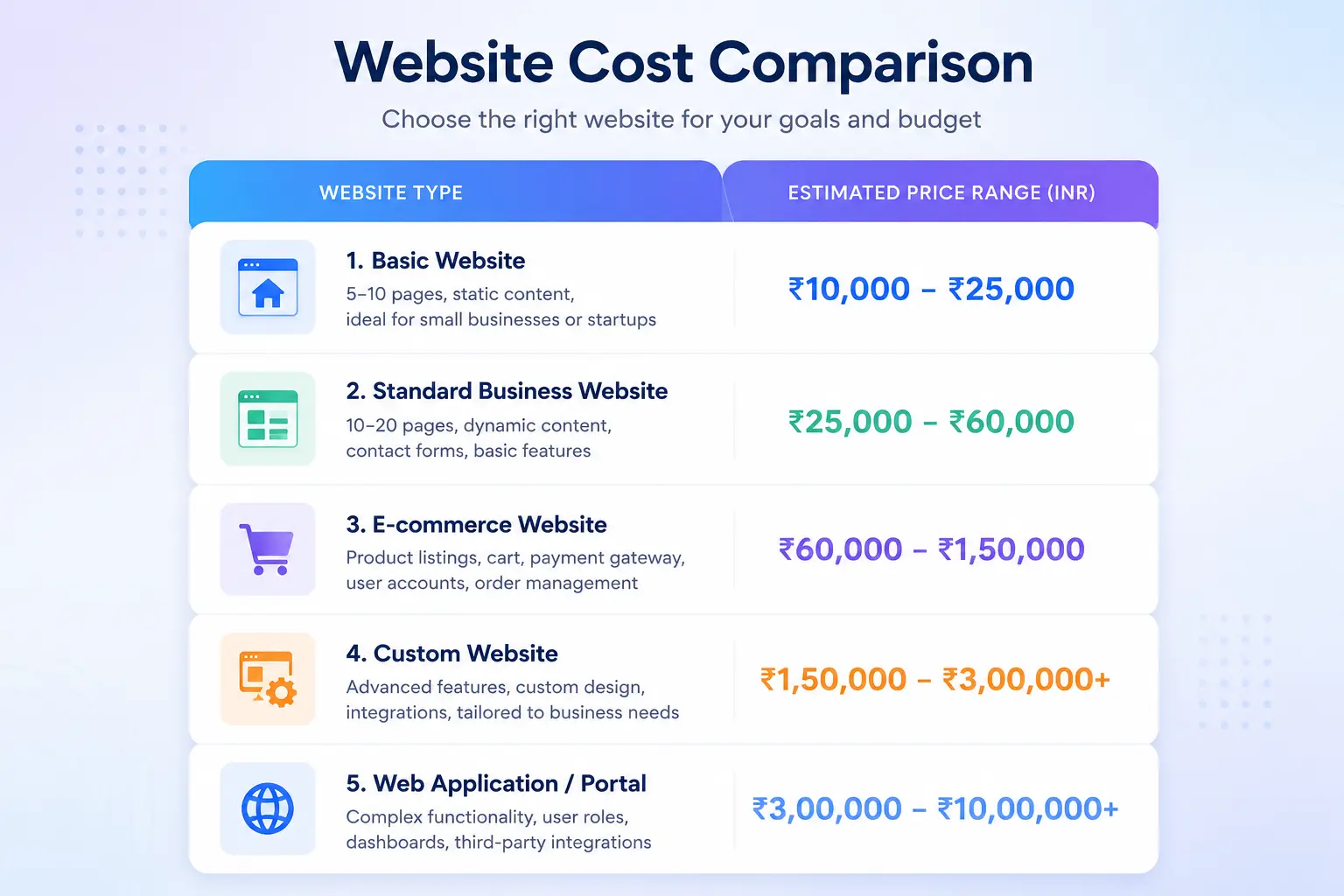
Numbers help more than adjectives. Here’s a realistic 2026 range, based on standard market rates across freelancers, small studios, and mid-size agencies:
| Website Type | Typical Cost Range |
|---|---|
| Single-page landing site | ₹8,000 – ₹25,000 |
| Business/brochure website (5-10 pages) | ₹25,000 – ₹80,000 |
| Custom-designed corporate website | ₹80,000 – ₹2,50,000 |
| Portfolio/personal website | ₹10,000 – ₹40,000 |
| Blog or content platform | ₹20,000 – ₹70,000 |
| Ecommerce store (basic) | ₹60,000 – ₹2,00,000 |
| Ecommerce store (advanced, custom features) | ₹2,00,000 – ₹8,00,000+ |
| Web application / SaaS platform | ₹3,00,000 – ₹15,00,000+ |
These aren’t official rate cards — nobody publishes one that means anything, because scope changes everything. But this is close to what you’ll see quoted across Mumbai, Bangalore, Delhi, and smaller-city agencies alike. Tier-2 city studios often run 20-30% cheaper for identical scope, mainly due to lower overhead, not lower skill.
It’s worth noting that these ranges shift with demand too. Around festive-season launches (September through November, ahead of Diwali sales), agencies that specialize in ecommerce builds often book out weeks in advance, and rush timelines can add 10-20% to the base quote — something to factor in if ecommerce website development cost is already tight against your launch date.
The bigger takeaway from this table: cost of website development in India rarely moves in a straight line with page count alone. A 10-page site with three custom-built calculators can cost more than a 40-page static blog. Ask what’s driving the number, not just how many pages are involved.
Freelancer vs. Studio vs. Agency: Where the Cost Actually Goes
This part gets skipped in most cost breakdowns, and it shouldn’t be, because the same website can carry three very different price tags depending on who builds it.
A freelancer typically charges the least — often 30-50% below an agency for comparable scope — with no project manager or office overhead baked into the cost of website development in India they quote. That works fine for a brochure site. It gets risky for anything complex, since one person is handling design, development, and client communication alone.
A small studio (3-8 people) sits in the middle, with a design specialist and a developer working separately — usually better UX and cleaner code, at a moderate premium. A full-service agency costs the most, but that premium buys project management, QA testing, and accountability if something breaks. For a business betting real revenue on the site — ecommerce, lead-gen funnels, anything with a payment flow — that structure is often worth paying for.
None of these are universally “right.” A ₹15,000 freelancer build is the correct call for a one-page portfolio. It’s the wrong call for a 200-SKU online store, where the ecommerce website development cost of getting it wrong — lost sales, a broken checkout, no one to call when the site goes down — outweighs whatever you saved on the invoice.
This is also where website design cost in India tends to swing the most between providers. A freelancer might charge ₹10,000 for design work that a studio quotes at ₹35,000 — not because one is overcharging, but because the studio is pricing in research, revisions, and a design system you can reuse later.
Website Design Cost in India vs. Development Cost
People often treat “design” and “development” as one line item. They’re not, and separating them explains a lot of the confusion around final quotes.
Design covers the visual layer: UI, UX research, wireframes, brand consistency, layouts across devices. Website design cost in India for a professionally designed 5-8 page site typically sits between ₹15,000 and ₹70,000, depending on whether it’s a template customization or a from-scratch system built around your brand guidelines.
Development is the build: turning that design into a functioning site, wiring up the backend, testing across browsers and devices, setting up hosting and security. This is usually the bigger line item, especially once custom functionality enters the picture — a contact form is trivial, a custom quote-generator tool tied to a database is not.
A cheap quote that skips proper UX work will save you money upfront and cost you conversions later. Visitors don’t stick around on a confusing layout, no matter how fast the page loads. That trade-off is worth thinking through before you pick the lowest bid on the table.
If your budget is tight, it’s usually smarter to protect the design line and trim elsewhere. A well-thought-out website design cost in India of ₹40,000 that converts visitors into leads beats a ₹15,000 template that nobody trusts enough to fill out a form on. And because design and development get quoted together so often, ask your agency to itemize both — it’s the fastest way to spot where a “discount” quote is actually cutting design hours.
Ecommerce Website Development Cost in India
This is where costs jump the most, and where vague quotes cause the most damage, mainly because “ecommerce site” can mean ten products or ten thousand.
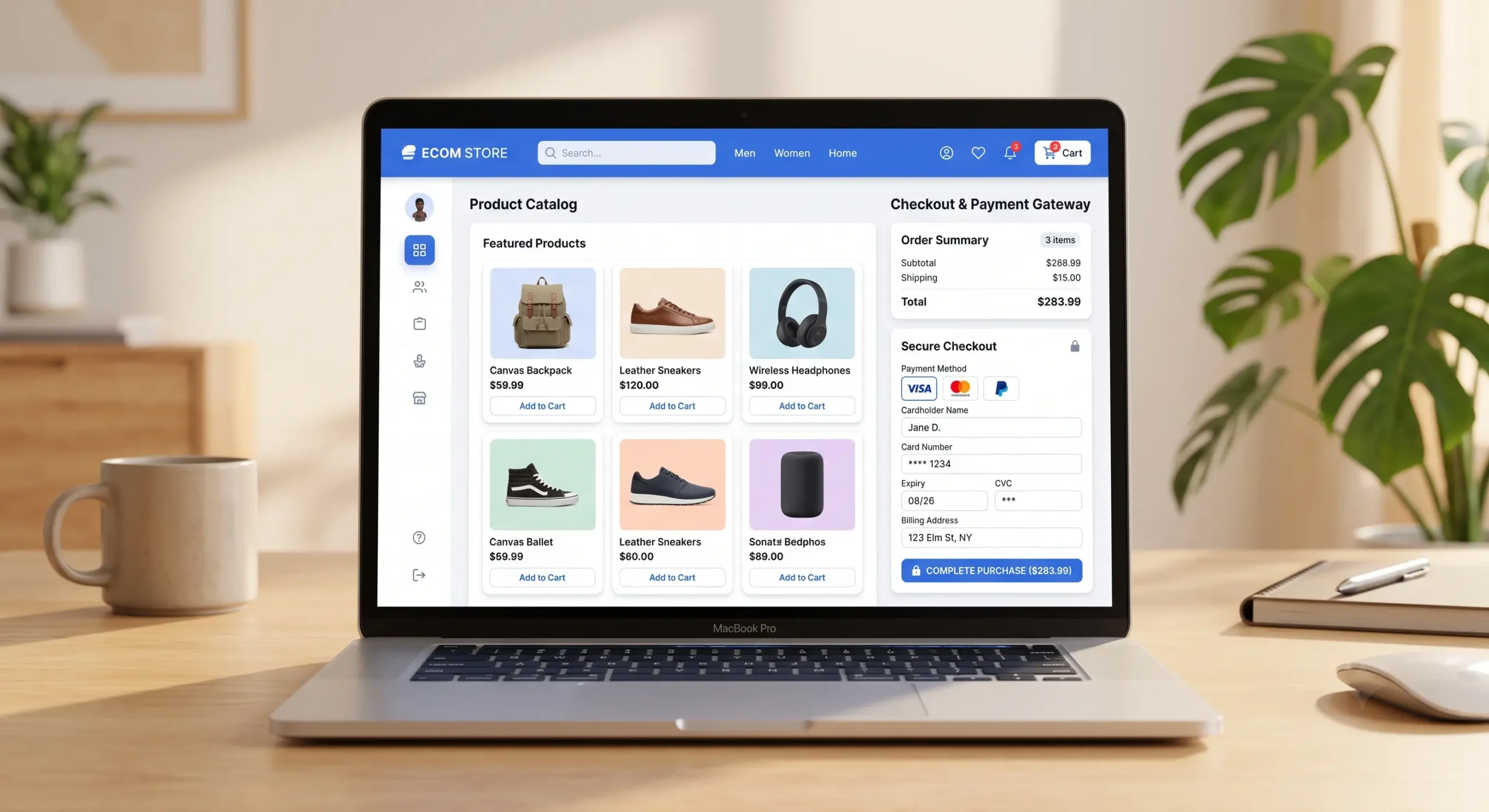
Ecommerce website development cost depends heavily on three things: the platform (Shopify vs. WooCommerce vs. custom-built), the number of products and categories, and the features layered on top — payment gateway integration, shipping API connections, inventory sync, customer accounts, abandoned cart recovery, and admin reporting dashboards.
A basic Shopify or WooCommerce store with 50-100 products, standard payment gateway (Razorpay, PayU, or similar), and a clean theme typically runs ₹60,000 to ₹1.5 lakh. Add custom design, multi-vendor support, or ERP/inventory integration, and ecommerce website development cost can climb past ₹3-5 lakh without much difficulty. Enterprise-grade builds with custom checkout logic, warehouse integration, and multi-region shipping rules can push well past ₹8 lakh.
One client we worked with — a home-décor brand scaling from Instagram sales to a full store — budgeted ₹80,000. By the time they added multi-currency support, a loyalty system, and a custom checkout flow, the final website development cost in India landed near ₹2.1 lakh. Not because anyone padded the invoice — the scope genuinely grew. That’s the pattern to expect: your first number is a floor, not a ceiling.
Payment gateway fees factor into total cost of ownership too, even outside the build quote — most Indian gateways charge 1.8-2.5% per transaction, which matters more for high-volume stores than the upfront bill ever will. Ask each vendor to break their ecommerce website development cost into platform licensing, design, integrations, and testing separately; a single lump-sum number hides which part of the build is eating your budget.
Hidden Costs Nobody Mentions Upfront
A quote that looks clean on day one often isn’t the full picture. Here’s what tends to get left out:
- Domain and hosting — ₹1,000-₹15,000/year depending on hosting tier
- SSL certificates — sometimes free, sometimes a paid add-on
- Third-party plugins or premium themes — one-time or annual licensing
- Content writing and photography — rarely included in a “website” quote
- Post-launch revisions — most agencies cap free revisions at 2-3 rounds
- Ongoing maintenance — security patches, backups, uptime monitoring
- Analytics and tracking setup — often sits outside the base scope
None of these are scams. They’re just costs that live outside the base build, and a good agency tells you that on the first call, not three weeks after launch in an email. This is exactly why comparing website development cost across two agencies on price alone rarely works — the lower number often just means fewer line items disclosed, not less work required.
How to Bring Down Website Development Cost Without Cutting Corners
You don’t need the cheapest quote. You need the right scope at a fair price. A few things actually move the needle.
Start with a template-based build if your brand doesn’t need a fully custom visual identity yet — you can redesign later once the site is proving itself. Bundle content and copywriting into the same team’s scope instead of hiring separately; context-switching between vendors adds delay and cost.
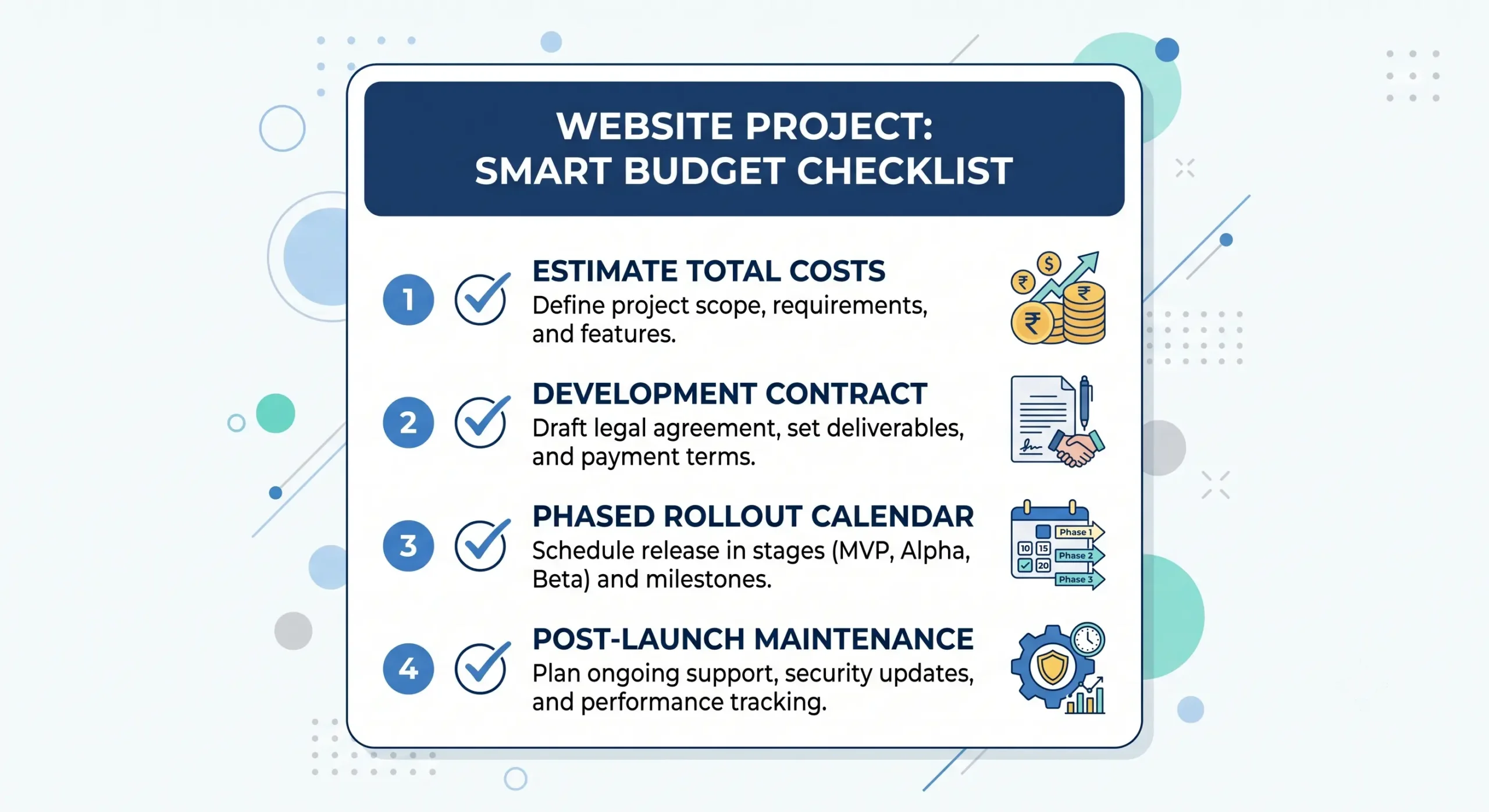
Ask for a fixed-scope contract, not an hourly one, so feature creep doesn’t quietly inflate your invoice. And get the maintenance cost in writing before launch, not after your first bug report. Cutting the design budget is usually the wrong place to save. Cutting scope — fewer pages, phased feature rollout — is almost always the right one.
For ecommerce specifically, phasing is where the ecommerce website development cost really comes down. Launch with your core catalog and a standard checkout, then layer in loyalty points, multi-currency, or subscription billing once you’ve validated demand. Building all of it on day one, before you know which features customers actually use, is the single most common way stores overspend on their first build.
Rushed timelines cost more too, and it’s an easy lever to miss. A 4-week build usually means a smaller team working longer hours to hit the date, which pushes the price up. Say so upfront if budget matters more than launch date — most agencies will requote a relaxed timeline lower without being asked twice, and it’s often the simplest way to bring down website development cost without touching design or features at all.
The Bottom Line
Website development cost in India isn’t one number, and anyone who gives you a flat figure without asking about your pages, platform, and features is guessing. The same logic applies whether you’re comparing website design cost in India across two studios or weighing ecommerce website development cost across three platforms — the number only means something once the scope behind it is clear.
What you can control is asking the right questions upfront: what’s included, what’s billed separately, and what happens after launch. Get those three answered clearly, and the cost of website development in India you’re quoted will hold up six months down the line, not just on launch day.
FREQUENTLY ASKED QUESTIONS
What is the average website development cost in India?
Most business websites cost between ₹25,000 and ₹1.5 lakh, depending on design complexity, page count, and features.
Is website design cost in India separate from development cost?
Yes. Design covers layout and UX; development covers building and coding the site. Agencies often quote them together, but they’re distinct work.
How much does ecommerce website development cost in India?
A basic store typically runs ₹60,000 to ₹2 lakh; advanced stores with custom features can exceed ₹5 lakh.
Why do website development cost quotes vary so much between agencies?
Differences in scope, platform choice, team size, and whether hosting or maintenance is included all affect the cost of website development in India.
Does the cost of website development in India include hosting and domain?
Usually not by default — confirm this upfront, since hosting, domain, and SSL are often billed separately.
Can I reduce website development cost without lowering quality?
Yes — start with a template-based build, phase in advanced features later, and lock a fixed-scope contract to avoid cost creep.